Each year, Historic Salem, Inc. (HSI) invites the community to celebrate excellence in preservation by nominating outstanding restoration and renovation projects for our Preservation Awards. Whether a meticulous home restoration, a period-appropriate garden, or the conservation of a historic monument, these projects stand as inspiring examples of preservation at work.
We’d like you meet our 2018 Preservation Award Recipients. Special thanks to Ty Hapworth (@hellosalem on Instagram) for lending his talents and photographing this year’s winners!
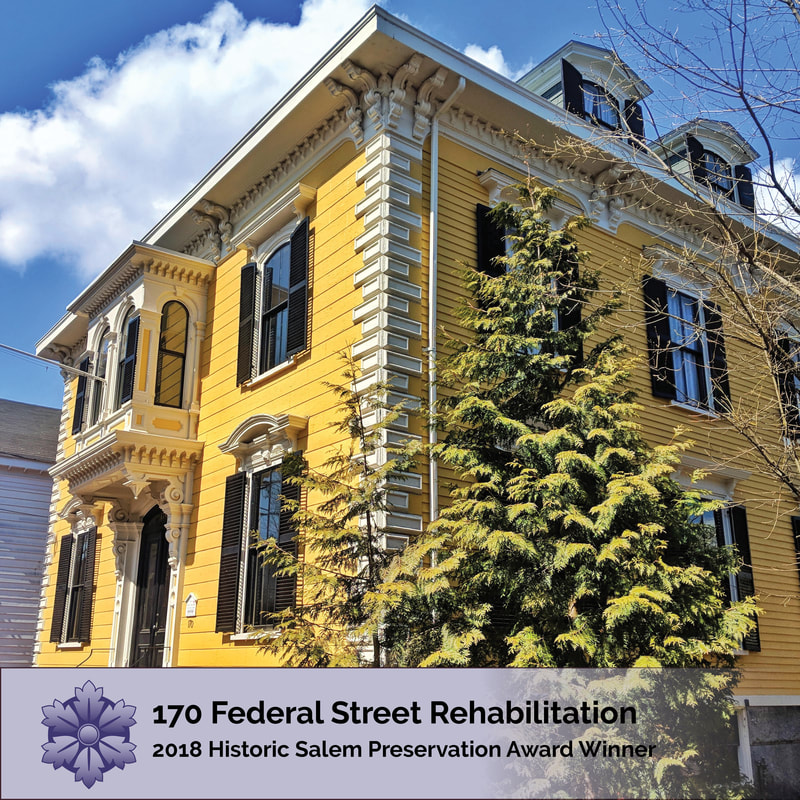
170 Federal Street
Homeowners Tim Obert & Matt Obey facilitated a complete rehabilitation of the exterior of 170 Federal Street. A few highlights include the restoration of all original wooden sash windows, the complete restoration and extension of the original wrought iron fence, and the installation of a brick sidewalk and driveway. In addition, the original stained glass entrance doors were restored, reconstructed, and re-leaded, and arched second-floor windows previously hidden behind rectangular storm windows were exposed. The granite entrance steps and the original carriage step were reset and the garage restored, with new swing-out wooden doors fabricated and installed. Deteriorated soffit woodwork was also restored around the entire roofline. Many people were responsible for 170 Federal’s transformation, most notably McLaughlin Masonry, DeAngelis Iron Work, and carpenter John Obey.
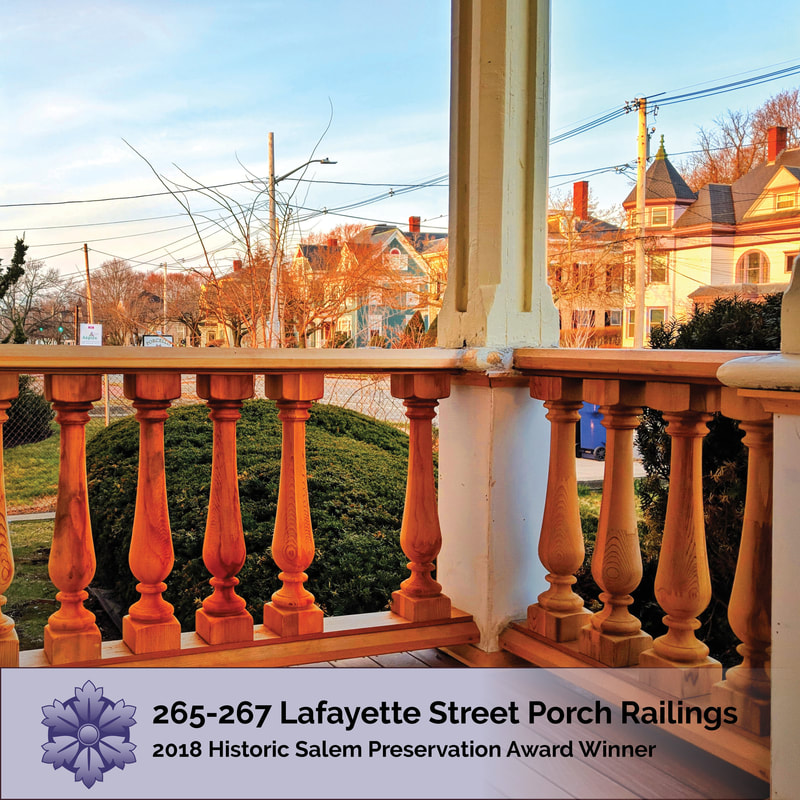
265-267 Lafayette Street
Historic Porch Railings. The owners of the historic Harris-Webb House at 265-267 Lafayette Street began restoring it in 2017. After they repainted the wooden clapboards, incised corner pilasters, paired curvilinear cornice brackets with pendants, open pediment dormers, and thin segmental-arch window caps, they began work on the front entrance porch, which was in serious disrepair. The owners took the opportunity to restore the historic appearance of the porch – what Bryant Tolles called “pleasantly light and understated.” New mahogany turned balusters were created to match others found on Lafayette Street. New handrails and column bases were also installed. Typically the Historical Commission does not nominate a restoration project until all work has been completed, however, in this instance, the commission recommended honoring the property owners’ efforts to date as a means to address conflicts between historic building designs and modern building codes. After the owners of 265-267 Lafayette Street installed the new porch railings, they were notified that the railings did not comply with current code requirements for railing height, even though they matched the original porch design. The Massachusetts State Building Code allows exemptions for museum buildings only; there are no exemptions for buildings listed in the National Register or designated within a local historic district. The Historical Commission will be assisting the owner in seeking an appeal of the building code requirements to allow the retention of the historically appropriate railings.
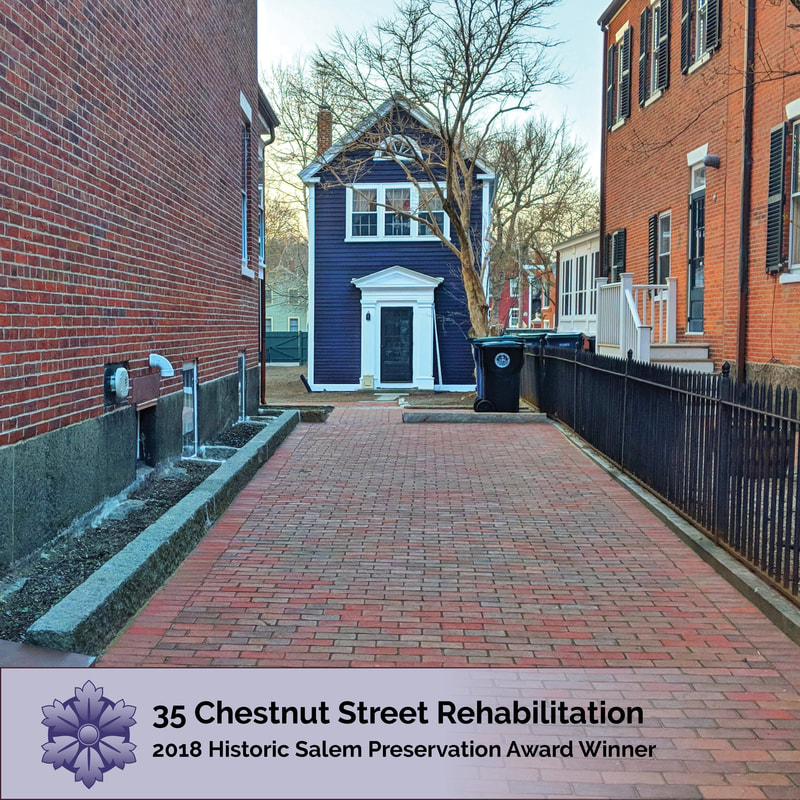
35 Chestnut Street
When Dan Randall and Phil Gillespie realized that 35 Chestnut Street, a grand rowhouse recently vacated and next to their own home, could potentially be stripped of its historic interior details, they redefined good neighbors by purchasing the rowhouse and undertaking a complete restoration of the Federal-style residence, in partnership with their architect, Helen Sides and carpenter, Jef Grinarml. Dan and Phil received Massachusetts Historic Rehabilitation Tax Credits for the project, which is an innovative solution for a smaller scale residential rehabilitation and requires careful protection of historic materials. The project included restoration of the building’s 6 over 6 wood window sashes, repointing of the brick and brownstone exterior, and preservation of the interior woodwork. In addition, the owners restored the property’s original carriage house, including removal of wood shingle siding to reveal and preserve the building’s original wood clapboards and trim. The restoration of the carriage house included preservation of interior woodwork and an entry that was installed when the carriage house was converted to residential use around 1912. These architectural elements were moved from a house that once stood at 21 Federal Street. A new historically appropriate porch was also added to the south (Warren Street) elevation of the carriage house and a new fence was installed along Warren Street. The entire project is beautifully completed but the selection committee was particularly charmed by the care given to this small accessory dwelling.
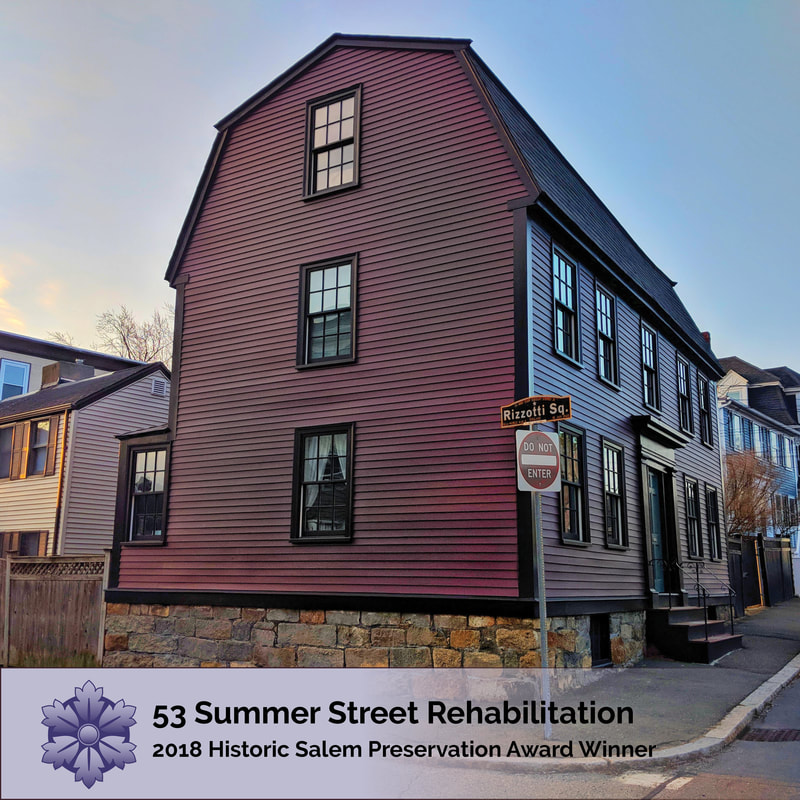
53 Summer Street
Christopher and Stacey Norkun’s search for the perfect home took over two years and 80+ showings. Finally, 53 Summer Street emerged – a weather-beaten 1756 gambrel that surely scared away most buyers. This house was once considered for demolition during the 1914 Salem Fire as a way to interrupt the path of the conflagration. Though spared that fate, it had been neglected in the intervening century and to say the house was in “rough shape” is an understatement. Nevertheless, all Chris and Stacey saw was potential. They could see past the rotted windows, the marred floors, and the ceilings that were caving in from years of water damage. They were bravely ready to take it on and become stewards of its history; to give something back to Salem, the city that has always held a special place in their hearts. Exterior work completed on 53 Summer Street includes the repair and replacement of the roof; the repointing of the fieldstone foundation; the replacement of 26 windows and all surrounding trim and sills; the removal and repair of all exterior dry rot; the painting of the exterior; and the rebuilding of the front steps. Interior work includes the repair of plaster damage from sill rot; the repair of plaster ceilings due to heavy water damage; the repair and restoration of the hardwood floors; and the renovation of the Front Parlor, Dining Parlor, Bathroom, Master Bedroom, and Guest Bedroom.

55 Federal Street
The Greek Revival building located at 55-57 Federal Street was constructed c. 1836 by Joshua Loring as a double residential home. The building located at 59 Federal Street was constructed c. 1850 as a residential property. By 1890 the buildings were connected by a two-story ell. Portions of both buildings were later renovated for office use and over time the buildings fell into disrepair. When Salem Renewal LLC purchased the buildings, they continued their proud tradition of rehabilitation. In partnership with Seger Architects of Salem, they converted the buildings into 9 residential units. The exterior materials including the siding, trim, windows, and roof were all restored or replaced and the interior woodwork, fireplaces, and staircase were completely refurbished. Proposed work qualified for Historic Tax Credits, which require stringent adherence to the Secretary of the Interior’s Standards and the buildings are now a proud complement to the historic neighborhood of the Federal Street district.

Congress Street Residences
Congress Street Residences is a significant neighborhood revitalization initiative in the Point neighborhood by the North Shore Community Development Coalition. Through the restoration and preservation of eight distressed historic buildings in the neighborhood, the North Shore CDC created 64 quality affordable homes and a community center. The organization acquired the buildings in December 2014, began the project in Spring 2016, and completed the restorations in November 2017. The rehab of the buildings included roof, mechanical systems, and window replacement, extensive masonry repairs, all new kitchens and baths, and unit reconfiguration in most buildings. Once overlooked, North Shore CDC has transformed these decrepit buildings into affordable housing that people want to call home. Before, these 66 units rehabbed– apartment layouts were not suitable for modern living and there was a lack of overall care for the buildings. Today, 64 modern, affordable homes have been restored to incorporate the historic charm of the buildings like built-in cabinets and decorative trim. North Shore CDC also transformed two former units into a community space called Espacio, located at 105 Congress Street. This 2,000-square -foot space fully restored the exterior look of the building, bringing back the commercial storefront and updating the brick façade. Espacio is also home to the nonprofit’s Family Resource Center – a place for free programming for community members to take ESL classes, dance lessons, Immigration Services, and more. This multi-functioning space brings back the original layout of the building, and includes modern amenities such as a colorful kitchen and conference room. This project is an excellent example of long-term planning and maintenance of historic buildings, to the benefit of the entire community.
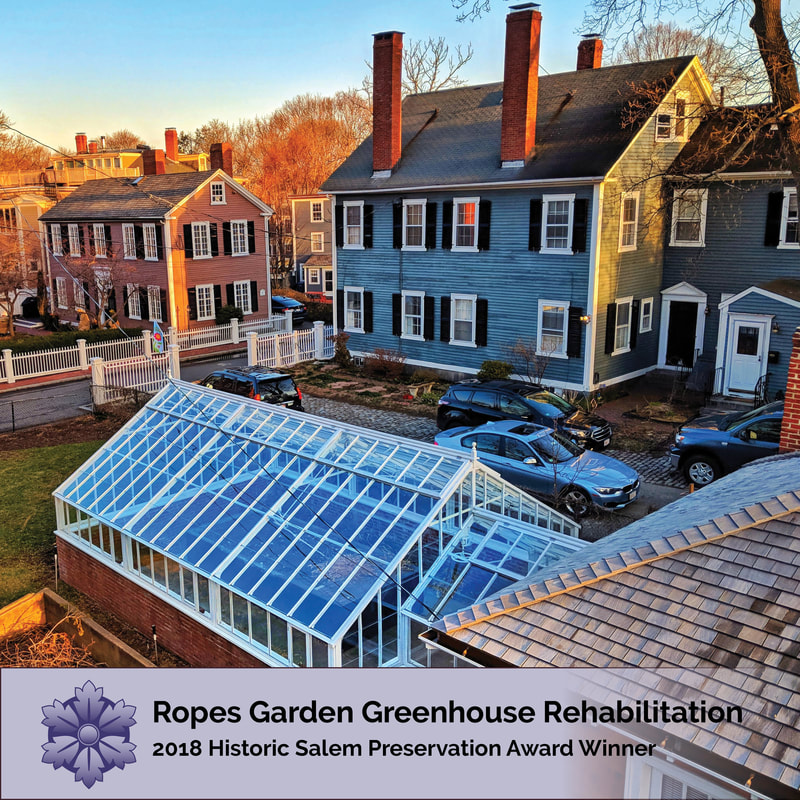
Ropes Garden Greenhouse & Potting Shed
Another charming accessory structure is found behind the Ropes Mansion. The impeccably restored potting shed accessed through the back gate of the garden adds stature to the professionally kept Ropes garden. The shed started life as a garage in the early 1900s and was moved back from the street when the greenhouse portion was added around the 1930s. After storm damage in 2015, the restoration efforts focused on sourcing old growth tidewather “sinker” Cyprus to replace damaged framing for the glass. Any unbroken material was able to be reused. Proving that details matter, the restoration “wavy” glass installed on vertical surfaces is simple yet stunning. This season the greenhouse and shed will be used for education, plant propagation and winter plant protection. The Peabody Essex Museum assembled an all-star team for this elegant project including: American Steeple and Tower, Cassidy Bothers Forge, Robert Ouellette, Weaver Glass, John Jeffers and Precision Painting.

The House of Seven Gables
The House of the Seven Gables Settlement Association was founded in 1910 by Salem philanthropist and early historic preservationist Caroline Emmerton. Capitalizing on the Turner-Ingersoll Mansion’s connection to Nathaniel Hawthorne (who used it as the setting for his 1851 novel, The House of the Seven Gables), Emmerton rescued the 1668 mansion, restored it, and opened it to the public as a museum, using ticket sales specifically to fund social services for Salem’s newly arrived immigrants. Over the past century the Trustees of The House of the Seven Gables Settlement Association have followed Emmerton’s leadership and stewardship example. Over time they have acquired and maintained additional historic structures, including the Retire Beckett House (1655), the Hooper-Hathaway House (1682), Hawthorne’s Birth Place (c.1750), and the Phippen House (1782). In 2007, the campus was designated a National Historic Landmark District, signifying its high level of historic integrity and the significant role it plays in interpreting 3 ½ centuries’ worth of stories relevant not only to the heritage of the region, but to the architectural, economic, literary, and social history of the nation. Most recently the Settlement Association has undertaken stabilization of the Summer beam in the Gables, allowing the dining room to be open to the public as well as more practical projects including four new roofs. Through the efforts of the House of the Seven Gables Settlement Association we see an important example of stewardship of our shared history and culture. This year the Gables is proud to celebrate the Turner-Ingersoll Mansion’s 350th anniversary and HSI was proud to present them with an award for a Century of Stewardship.