HISTORIC SALEM INC
  • Home
    • About HSI
    • Mission
    • Board & Staff
    • JOIN & GIVE >
      • Join or Renew Membership
      • Donate
      • Volunteer Opportunities
      • Join Our Mailing List
    • The Bowditch House >
      • Nathaniel Bowditch
    • Contact Us
  • Preservation
    • Preservation Award Recipients
    • About the Advocacy Summaries >
      • 301 Essex - Former Jerry's
      • Pioneer Village and Camp Naumkeag
      • Demolition Delay
    • Protecting Neighborhoods >
      • North Salem and Mack Park
      • Bridge Street Neck Neighborhood
      • Salem Willows Neighborhood
    • Council Candidates 2025
    • Protect Historic Resources >
      • Brick Committee
    • New Development in Historic Neighborhoods
    • Successes >
      • 2011 Update of Renewal Plan
      • 1740 Samuel Pope House
      • Beckford Way
      • Historic Salem Jail
      • Wendt House, 18 Crombie Street
    • For Historic Homeowners
    • Planning & Study Documents
    • Archives
  • Histories & Plaques
    • Overview
    • HHP Request Form
    • Refresh Your Plaque
    • House Relocation Database
    • HSI House History Database
  • TALK ABOUT DESIGN
    • Citizens Guide to the Downtown Renewal Plan >
      • Design in Historic Context Panel
    • Preservation Education
  • CHRISTMAS IN SALEM
    • Christmas in Salem
  • News & Events
    • News and Opinion
    • Video

Kate Tannant Woods (1835 - 1910)

3/30/2020

0 Comments

 
By Polly Wilbert and Pat Donahue

An excerpt from the last poem written by Kate Tannatt Woods in the days before she died and published in National Magazine, Vol. 43 after her death:
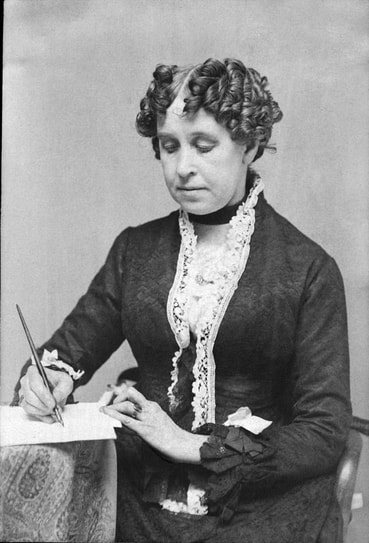
PicturePhoto: Peabody Essex Museum
​The Temple of My Soul
 
I give thee thanks,
O Temple of my Soul
That thou hast bravely held
God-given power to share
With others on my way
To do and dare,
To feel the bliss of life
The sacred depths of joy
With earth’s alloy.
 
I give Thee thanks, dear God.
For power to work
From night to morn;
For love of children
Near my heart once borne;
For love of faithful friends
Grand, noble, ever dear
Whose courage gave me strength
From year to year.
 
And now, O Temple,
If the hour has come
And my once earnest voice
Must now be dumb,
If this once busy pen
Must tire and rust,
I still will thank thee
And my Maker trust.

​Kate Tannatt was born in Peekskill, New York, where her father, James, was an editor. Her mother was descended from an old Scottish family named Gilmour that in the 19th century still owned a castle near Edinburgh. Kate briefly attended the Peekskill Seminary and then, because of ill health, had private instruction. Following her father’s death when she was 10, the family moved to Salem, drawn in part by the excellence of New England public schools and to be closer to other family members. 
 
When not much older than the students she was teaching, Kate briefly taught public school in Salem, and was still in her teens when she met and then married a lawyer George Henry Woods on July 22, 1857. From a Salem family, he was a graduate of Brown and Harvard Law, and had a successful practice in Minneapolis, where they went to live. 
 
When the Civil War began, George Woods raised a company of Minnesota soldiers for the Union Army and became a lieutenant colonel. While serving on General Sumner’s staff, he was severely wounded near Richmond, Virginia, during the Seven Days battle of the Peninsula campaign in late June 1862. Kate was then living with their two young children in Washington, D.C. and volunteering as a nurse at the front, and was able to care for her husband there. After Lincoln’s assassination, Woods was one of the honored bodyguard during the funeral. He was mustered out in July 1865, and the family returned to Salem to live at 166 North St., which Kate called Maple Rest. Maple Rest was a house on a triangle-shaped plot of land in North Salem, which was owned by George’s father, the highly successful nursery owner Ephraim Woods. The property held several houses built in 18th and 19th centuries.
 
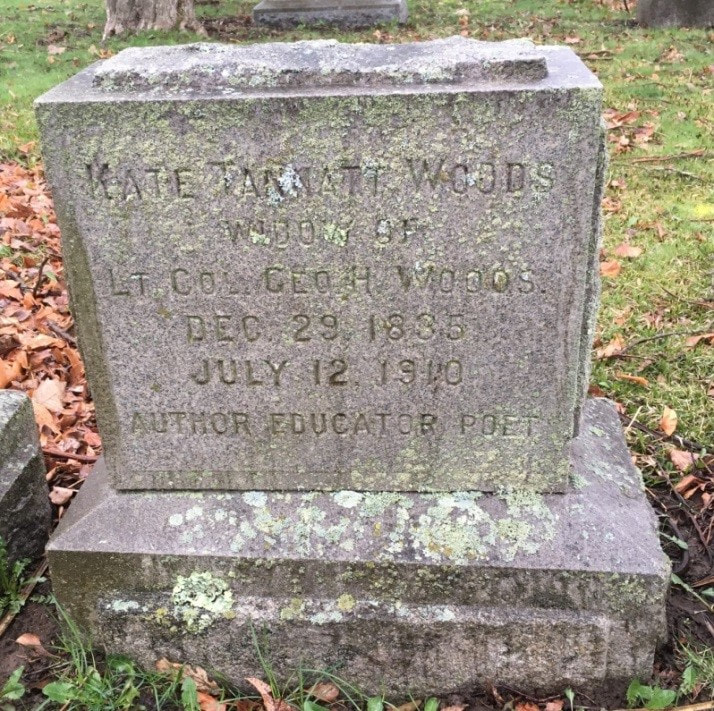
George never fully recovered from his wounds, but often had to travel for work, including for several years to Decatur, Illinois, where he did grain trades by commission from a shared office. He died on September 30, 1884, and Kay was buried by his side in Greenlawn Cemetery after her death in the summer of 1910.
 
Kate was a founder of the Woman’s Friend Society (1876), which provided “an employment bureau, a reading room, and a home for young woman”. Emmerton House on Hawthorne Boulevard continues as the Friend Society residence for 20 single working women. About 1899, Kate opened a tea room, the Ladies Lunch and Tea Club and Woman’s Exchange, at 36 Lynde Street, where the Thought and Work Club (1891-1974) met twice a month. The club, with Kate as founding president, had been formed to encourage women “in all departments of literary work, to promote home study, and to secure literary and social advantages for its members”. It grew to 300 members, organized civics classes, which were addressed by city officials and state senators, and held foreign-language classes.  The club also worked to improve local schoolrooms, clean the streetcars, and elect women to the school board.   . 
 
Over the years, Kate wrote articles for newspapers such as the St. Paul Pioneer (Minnesota), the Omaha and New England newspapers and popular stories for juveniles for periodicals like St. Nicholas, Wide Awake and others. Historian Sidney Perley described her editorial work for the Boston Globe and American Home Magazine as “clear, terse, and vigorous”. She was also an editor of Harper’s and The Ladies Home Journal. She was a poet whose poems were widely quoted, and she painted in oils and watercolor and was respected for her needlework.  For many years, she often wrote a book a year, with such titles as:  That Dreadful Boy, The Minister’s Secret, Hidden for Years, Hester Hepworth, Toots and What He Did, and A Fair Maid of Marblehead. In later years she gave up her house and lived at 8 Federal St. She died at the home of her son, Dr. Prince Tannatt Woods, in Buffalo, New York.

Greenlawn Cemetery

166 North Street, Salem, MA - 1897
Sources:
Wikipedia:  Kate Tannatt Woods
The Poets of Essex County, Massachusetts, Sidney Perley, 1889
Genealogical and Personal Memoirs Relating to the Families of Boston and Eastern Massachusetts, Vol. 1, edited by William Richard Cutter, Lewis Historical Publishing Company, 1908
National Magazine, Vol. 43
The Thought and Work Club was active in Salem 1891-1974
 
This information was gathered during research for a past Friends of Greenlawn tour at Greenlawn Cemetery.
0 Comments

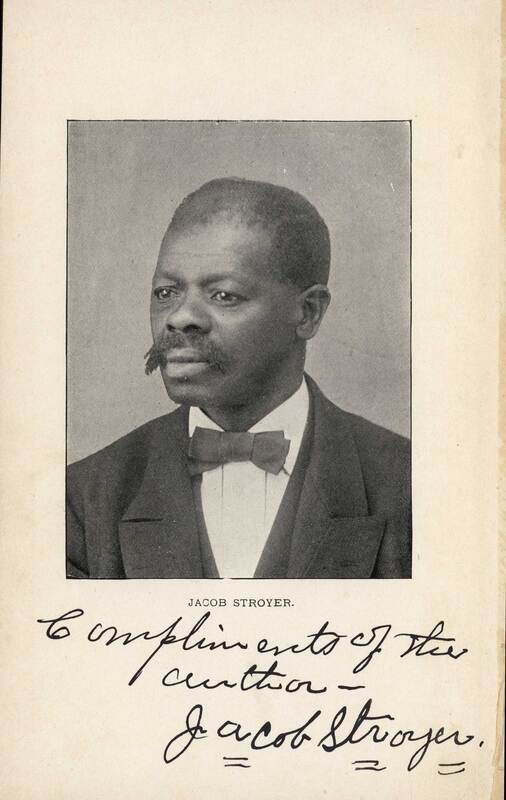
For 25 Years Minister to Salem's African-Americans: The Rev. Jacob Stroyer ​(ca. 1849-Feb. 7, 1908)

3/6/2020

0 Comments

 
Picture
The Frontpiece of My Life in the South

By Polly Wilbert​
​
Jacob Stroyer, a former South Carolina slave, lived and ministered to African Americans in Salem for 25 years.  He wrote a memoir of slavery, My Life in the South, which was published in 1879 and in later editions and reprints. Proceeds from the book’s sales helped him further his theological education in the 1880s at Talladega College in Alabama and at Oberlin Seminary in Ohio.  Excerpts from Stroyer’s memoir were included more recently with seven other individual histories of slavery in From Bondage to Belonging: The Worcester Slave Narratives, and his experiences continue to be referenced in the study of African-American history.
 
One of 15 children of his father, who was known as Will, a slave brought from Sierra Leone, and his mother Chloe, a slave born in South Carolina, who was his father’s second wife, Stroyer was one of 465 slaves (as many as 150 of them children) on the Singleton plantation near Columbia, S.C.  Of his time on the plantation, Stroyer wrote in detail of frequent violent whippings and harsh beatings by overseers, whom his parents were powerless to stop and who prayed daily for freedom for themselves and their children. When he was an old enough child, he worked with horses, helped with hogs, and for a brief time served as a helper to a plantation carpenter, which was stopped by the overseer who sent him to work in the fields as punishment for his independent spirit.
 
In 1863, Stroyer was among ten slaves taken, along with more from other plantations, to work on fortifications on Sullivan’s Island at Charleston, SC and to wait on Confederate officers.  After a return to the plantation, in 1864, he was sent to work at Ft. Sumter, where he was wounded in July in a nighttime Union bombardment, taken to a hospital in Charleston, and then returned to Columbia, where he was when President Lincoln freed the slaves. At about the time of the Emancipation, General Sherman was camped at Columbia. Stroyer wrote that Sherman’s troops pillaged the plantation for stores, horses, and mules for their march through Georgia, but took nothing from the slaves.
 
After the war, Stroyer, who had learned to read a little (which was illegal for a slave), went to school, first in Columbia, then in Charleston, and, in 1870, to Worcester to evening schools and then for two years (1873-1874) to Worcester Academy. He was licensed as a preacher of the African Methodist Episcopal Church, and, in 1876, ordained a deacon in Newport, R.I. 
 
Stroyer’s move to Worcester was likely due to his meeting the Rev. T. Willard Lewis, pastor of Worcester’s Laurel Street Methodist Church, who first went to South Carolina as a missionary in 1862 and to Charleston, when it fell in 1865, to minister to and organize black Methodists.  Records show that in 1867, Mary (Perkins) Stroyer (Jacob’s 14-year-old wife, born in Camden, SC; Stroyer was about 18) was working for Lewis as a cook and laundress.  Lewis may have used his connections to help Jacob move to Worcester to continue his education.  Lewis died of yellow fever in Charleston in 1871 and is buried on Sullivan’s Island, with a tombstone that records his support of and ministry to freed slaves.
 
Worcester’s 1870s census listings describe Jacob as either a laborer or a carpenter.  The 1880 census lists Jacob and Mary at 3 Lilly Street, Worcester, with Jacob being a “book agent” and Mary, a domestic servant.    However, records also show that in 1878 Mary had started legal proceedings against Jacob for desertion.  (In 1879, Jacob is listed as living at 19 Harbor Street, Salem -- now condo’s.  In later years, he boarded at 41 Roslyn St.)  In 1880, Mary purchased a house at 3 Bath Street, Worcester, where her sister and brother-in-law were also listed as living in 1882.  Mary was “active in the AME Zion Church and Good Samaritan Lodge until her death at age 35, in 1888”, and left her house to two sisters. 
 
In 1877, at the invitation of the minister of Salem’s South Church, Jacob came here, where he preached and ministered off and on for 25 years to Salem’s small (about 300) African-American community as founder and pastor of the Salem Colored Mission.  It’s possible that no one in Salem, or possibly only a few intimates, knew that Stroyer was married.  He died, in February 1908, from heart disease following a bronchial infection. His funeral was attended by 400 of Salem’s community, including the mayor.  The text on his Greenlawn gravestone, paid for by Stroyer’s friends, chronicles his life and his slavery as detailed in his memoir, but makes no mention of Mary.

Note: The research for this article was initially undertaken for a past Friends of Greenlawn tour at Greenlawn Cemetery. 

Sources:
My Life in the South, Jacob Stroyer
National Humanities Center, Excerpts from My Life in the South
Website for From Bondage to Belonging: The Worcester Slave Narratives
Blogpost, Clark University Professor Janette Thomas Greenwood, The Camden-Worcester Connection, The Rev. T. Willard Lewis (research on the Perkins family)
Ancestry.com:  Mary Stroyer bank account application, Charleston, SC; Salem Colored Mission information

0 Comments
    DONATE & SUPPORT

    Categories

    All
    301 Essex Street
    75 North Street
    Ada Louise Huxtable
    Adaptive Reuse
    Advocacy Alerts
    Christmas In Salem
    Comment Letter
    Contextual Design
    Demolition Delay Waiver
    Design Review Board
    Enoch Fuller
    Events
    Five Broad Street
    Historic Courthouses
    Historic House Crush
    Historic House Plaque
    Historic Resource
    Historic School
    Homeowner Resource
    Leslie's Retreat
    Mayor Driscoll
    Neighborhoods
    North River Canal Corridor
    Photographs
    Podcast
    Point Neighborhood
    Position Statements
    Recommendation
    Salem Common Neighborhood
    Salem Handbook
    Salem Historical Commission
    Salem Matters
    Salem Redevelopment Authority
    Salem's History
    Shop
    Summer Party
    Support Letter
    Urban Renewal
    Windows
    Zoning Board Of Appeals

    Archives

    October 2025
    July 2025
    June 2025
    May 2025
    April 2025
    February 2024
    October 2023
    April 2023
    March 2023
    January 2023
    December 2022
    November 2022
    September 2022
    August 2022
    July 2022
    June 2022
    May 2022
    February 2022
    January 2022
    September 2021
    July 2021
    May 2021
    April 2021
    October 2020
    September 2020
    July 2020
    June 2020
    March 2020
    January 2020
    September 2019
    May 2019
    February 2019
    January 2019
    December 2018
    November 2018
    September 2018
    August 2018
    July 2018
    June 2018
    May 2018
    April 2018
    January 2018
    December 2017
    October 2017
    September 2017
    July 2017
    May 2017
    April 2017
    March 2017
    February 2017
    December 2016
    November 2016
    August 2016
    July 2016
    June 2016

    Follow us on Instagram!

    @HistoricSalemInc
​Historic Salem, Inc. | 9 North Street, Salem, MA 01970 | (978) 745-0799 | [email protected]
​Founded in 1944, Historic Salem Inc. is dedicated to the preservation of historic buildings and sites.
Copyright 2025 Historic Salem, Inc. - All Rights Reserved
Historic Salem, Inc., HSI, Christmas in Salem and all associated original artwork, logos and
content on this site are the proprietary property of Historic Salem, Inc. Misuse of this intellectual
property is prohibited and may violate applicable law.
  • Home
    • About HSI
    • Mission
    • Board & Staff
    • JOIN & GIVE >
      • Join or Renew Membership
      • Donate
      • Volunteer Opportunities
      • Join Our Mailing List
    • The Bowditch House >
      • Nathaniel Bowditch
    • Contact Us
  • Preservation
    • Preservation Award Recipients
    • About the Advocacy Summaries >
      • 301 Essex - Former Jerry's
      • Pioneer Village and Camp Naumkeag
      • Demolition Delay
    • Protecting Neighborhoods >
      • North Salem and Mack Park
      • Bridge Street Neck Neighborhood
      • Salem Willows Neighborhood
    • Council Candidates 2025
    • Protect Historic Resources >
      • Brick Committee
    • New Development in Historic Neighborhoods
    • Successes >
      • 2011 Update of Renewal Plan
      • 1740 Samuel Pope House
      • Beckford Way
      • Historic Salem Jail
      • Wendt House, 18 Crombie Street
    • For Historic Homeowners
    • Planning & Study Documents
    • Archives
  • Histories & Plaques
    • Overview
    • HHP Request Form
    • Refresh Your Plaque
    • House Relocation Database
    • HSI House History Database
  • TALK ABOUT DESIGN
    • Citizens Guide to the Downtown Renewal Plan >
      • Design in Historic Context Panel
    • Preservation Education
  • CHRISTMAS IN SALEM
    • Christmas in Salem
  • News & Events
    • News and Opinion
    • Video